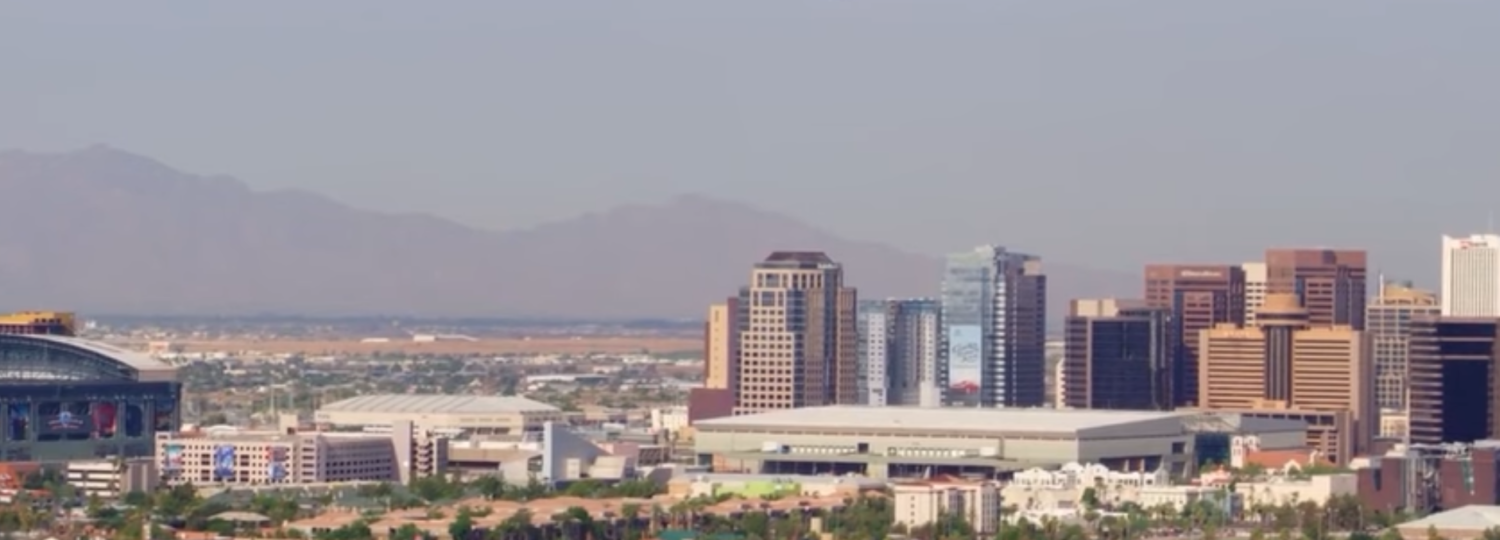
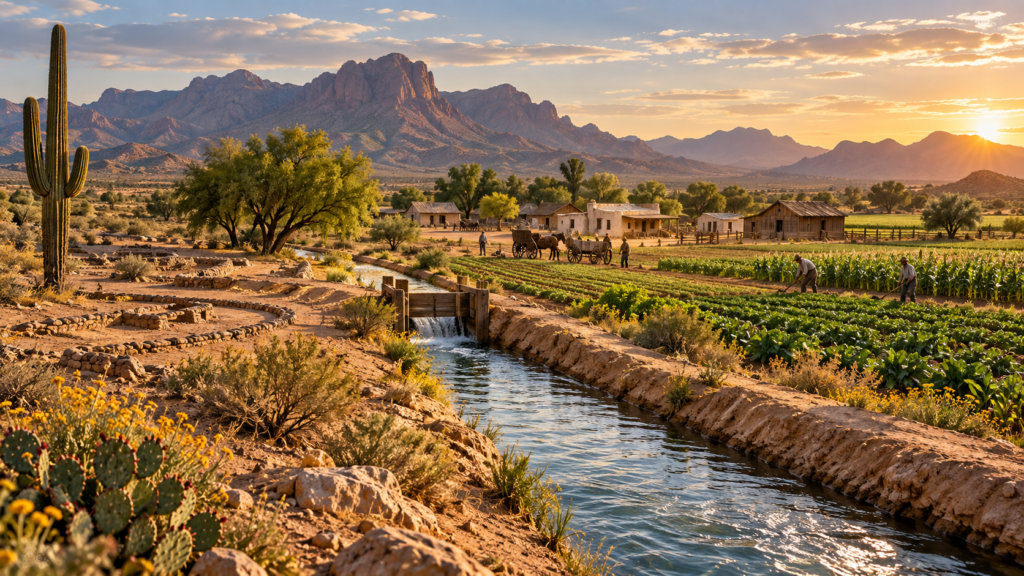
Phoenix, Arizona, started as a city because settlers saw that the dry Salt River Valley could become excellent farmland if they restored its ancient irrigation canals. In 1867, Jack Swilling helped organize a canal company, bringing water from the Salt River to fields in the desert. As more farmers, workers, and businesses arrived, the settlement grew into a town and was eventually incorporated as the City of Phoenix in 1881.
The city’s name reflects this story of renewal. Phoenix was named after the mythical bird that rises from its ashes because the new settlement developed on land once occupied and irrigated by the ancient Hohokam people. In a simple way, Phoenix was a new community rising from the remains of an older civilization.
The Land Before Phoenix
Long before modern Phoenix existed, the Salt River Valley was home to Indigenous communities, especially the people archaeologists call the Hohokam. These communities lived in central Arizona for hundreds of years and developed a remarkably advanced system of canals.
The Salt River provided water, but the surrounding landscape was still a hot and naturally dry desert. The Hohokam solved this problem by digging canals that carried river water to fields and villages. These canals allowed them to grow crops such as corn, beans, squash, cotton, and other plants.
Their irrigation network transformed the valley. Instead of being only a dry desert, the area became a productive agricultural region with villages, trade, and organized communities. Archaeological evidence shows that the ancient canal system covered a large area around what is now Phoenix and the surrounding cities.
The Hohokam also built homes, ceremonial structures, platform mounds, and ball courts. One important settlement was Pueblo Grande, located near today’s Phoenix Sky Harbor International Airport. The site demonstrates that the area had already supported a sophisticated society long before American settlers arrived.
By about the fifteenth century, many Hohokam communities and canals had been abandoned. Historians and archaeologists continue to study why this happened. Possible causes include changes in climate, flooding, drought, conflicts, and challenges connected to managing large irrigation systems.
However, the people did not simply vanish without leaving a legacy. Their descendants are commonly connected with Indigenous groups such as the Akimel O’odham and Tohono O’odham. Their knowledge of the desert and their canal-building achievements remained an important part of the region’s history.
Why Settlers Came to the Salt River Valley
Modern Phoenix began to develop during the 1860s, when American settlers, soldiers, miners, and farmers moved through central Arizona. The region was connected to nearby military posts and mining communities, creating opportunities for people who could provide food, transportation, and supplies.
Fort McDowell, established east of present-day Phoenix in 1865, increased activity in the Salt River Valley. Military personnel and nearby settlements needed hay, grain, vegetables, livestock, and other supplies. This created a practical reason to develop farms in the valley.
The land had several advantages:
- The soil was fertile in many areas.
- The valley had a long growing season.
- Winters were mild compared with colder regions.
- The Salt River could provide water for crops.
- The valley was close enough to military and mining communities to support trade.
There was just one major problem: water had to be carefully controlled. Rainfall was limited and unpredictable, so farming could not succeed without irrigation.
This is where the remains of the ancient canals became important. The old channels showed that the valley had once supported large-scale agriculture. For settlers, these ruins were more than historical remains. They were clues that the land could become productive again.
Jack Swilling and the First Irrigation Effort
Jack Swilling is widely recognized as one of the founders of modern Phoenix. In 1867, Swilling traveled through the Salt River Valley and noticed the potential of the land. He saw fertile soil and the remains of ancient irrigation canals.
Swilling understood that the valley did not need to be completely changed. It needed water to be brought back to the fields.
After returning to Wickenburg, he helped organize the Swilling Irrigating and Canal Company. The company began clearing and rebuilding a canal to divert water from the Salt River. The project was difficult because workers had to dig through desert soil using basic tools and labor-intensive methods.
By 1868, water was flowing through the canal. Farmers planted crops, and a small settlement began to form around the irrigated land. This was the practical beginning of modern Phoenix.
The first community was not immediately a large city. It was a small group of farms and homes. People came because they believed they could grow food, earn money, and build a stable life in the valley.
The settlement changed names several times. It was associated with Swilling’s Mill, Helling Mill, Mill City, and East Phoenix. Some residents also suggested names such as Stonewall and Salina. None of these names became permanent.
How Phoenix Got Its Name
The name Phoenix was suggested by Darrell Duppa, one of the early settlers in the area. The name referred to the mythical phoenix, a bird said to rise again from its ashes.
The name made sense because the new community was developing on land previously occupied by an ancient civilization. The Hohokam had built canals and farmed the valley centuries earlier. Now, settlers were restoring irrigation and creating another agricultural community in the same general region.
Phoenix therefore represented rebirth. It was a new settlement rising from the remains of an older one.
The name also expressed optimism. Early settlers were not only trying to survive in the desert. They believed the community could become a successful town with farms, businesses, schools, roads, and local government.
The name Phoenix became officially associated with the settlement in 1868. On May 4 of that year, the Yavapai County Board of Supervisors recognized Phoenix as an election precinct. A post office followed on June 15, 1868, with Jack Swilling serving as the first postmaster.
These developments gave the settlement a stronger connection to the rest of the territory. A post office meant people could communicate and conduct business more easily. Recognition as an election precinct meant Phoenix was becoming an organized community rather than a loose collection of farms.
The Townsite Was Moved and Planned
As the population grew, residents realized that the original farming settlement needed a proper townsite. In 1870, community leaders met to decide where the town should be located.
They selected a site west of the original settlement, near the area that is now downtown Phoenix. A total of 320 acres was purchased, and the land was divided into blocks and lots.
William A. Hancock, a surveyor, laid out the town. The plan included a grid of streets, with Washington Street serving as the main business street. The original townsite included 96 blocks.
This planned layout was important because it gave Phoenix a central business district and a structure for future growth. Stores, government offices, churches, homes, and public buildings could be built around the new town center.
A sale of town lots took place in December 1870. Sixty-one lots were sold at an average price of about $48 each. Although Phoenix was still small, the sale showed that people believed the community had a future.
The first store building in the new townsite opened in 1871. It served more than one purpose, functioning as a general store, meeting place, town hall, and government office. This was common in early frontier communities, where one building often had to do the work of several modern facilities.
Farming Was the Main Reason Phoenix Grew
The earliest economy of Phoenix depended on agriculture. Irrigation made it possible to produce crops in a desert environment, and farming created work for many different kinds of people.
Farmers needed laborers to plant, maintain, and harvest crops. They also needed blacksmiths, carpenters, merchants, transportation workers, mechanics, and people who could repair canals and equipment.
Early crops included:
- Wheat and other grains.
- Hay for animals.
- Cotton.
- Vegetables.
- Fruit and citrus crops.
- Alfalfa.
- Livestock and dairy products.
Water was at the center of almost every part of the economy. Canals carried water to farmland, while roads connected farms to stores and markets. The more reliable the water supply became, the more attractive Phoenix was to settlers and investors.
Mexican residents played an important role in the early development of Phoenix. Many helped build and maintain canals, level streets, farm the land, operate businesses, and provide essential services. A Phoenix historic survey notes that Mexican residents were a major part of the labor force that made early farming successful.
This contribution is sometimes left out of simplified accounts of Phoenix’s founding. The city was not built by one person alone. Jack Swilling helped launch the first major irrigation effort, but many different communities contributed labor, knowledge, business activity, and organization.
Why Phoenix Became a City in 1881
Phoenix was recognized as a settlement in 1868, but it did not officially become an incorporated city until 1881. This distinction is important.
A settlement can exist without having a formal city government. As Phoenix grew, its original system of town commissioners and later village trustees became less effective. The community needed a stronger government to manage roads, public safety, taxes, businesses, water, and other services.
By 1880, Phoenix had a population of about 2,453, along with stores, schools, churches, newspapers, banks, and other institutions. It was no longer just a small farming village.
The Arizona Territorial Legislature passed the Phoenix Charter Bill, and Governor John C. Frémont signed it on February 25, 1881. The charter officially incorporated Phoenix as a city and created a government with a mayor and four council members.
The first city election was held on May 3, 1881. John T. Alsap became Phoenix’s first mayor.
In other words, Phoenix started as a city because its population and activities had grown beyond what an informal village government could handle. Incorporation gave the community an official structure for managing its future.
The Role of Maricopa County
Another important reason Phoenix became influential was its connection to Maricopa County.
In 1871, the Arizona Territorial Legislature created Maricopa County by dividing Yavapai County. Phoenix became the county seat. This gave the town political importance and brought government activity, officials, legal services, and business opportunities to the community.
Being the county seat helped Phoenix attract more residents and businesses. People came to town to handle legal matters, conduct government business, attend court, buy supplies, and sell products.
The county government also strengthened Phoenix’s position as the central community in the Salt River Valley. Over time, the town became more than an agricultural settlement. It became a place where people from surrounding farms came for commerce and public services.
Railroads Helped Phoenix Expand
Irrigation started Phoenix, but transportation helped it grow.
Before the railroad arrived, goods had to be moved by wagon over long and difficult routes. This made products more expensive and limited the size of the local market.
In 1887, a Southern Pacific railroad connection reached Phoenix. The railroad made it easier to bring merchandise into the city and send agricultural products to markets outside Arizona.
This changed the local economy in several ways:
- Farmers could sell products to larger markets.
- Stores could receive goods more quickly.
- Businesses could expand their operations.
- More settlers could travel to Phoenix.
- Phoenix became a regional distribution center.
The railroad also encouraged new industries and warehouses. Phoenix’s location in the Salt River Valley, combined with irrigation and rail connections, made it an important commercial center.
By the late 1880s, Phoenix was developing the features of a modern city. It had newspapers, banks, schools, churches, electric power, streetcars, fire services, and growing public infrastructure.
Phoenix Became the Territorial Capital
Phoenix became the capital of the Arizona Territory in 1889. This was another major step in its development.
The capital brought government offices, public employees, visitors, and political activity. It also increased the city’s importance across the territory.
Phoenix’s location helped support the decision. It was centrally located in the Salt River Valley and had a growing population, agricultural economy, transportation connections, and expanding city services.
When Arizona became a state in 1912, Phoenix continued as the state capital. Its role as the center of government encouraged additional growth and investment.
The city’s political importance worked together with its agricultural and commercial strengths. Phoenix was no longer simply a place where farmers grew crops. It was becoming the administrative and economic center of Arizona.
Water Projects Secured Phoenix’s Future
The first irrigation canals helped Phoenix begin, but larger water projects helped the city survive and grow.
The Salt River could be unpredictable. Floods sometimes damaged canals and farms, while droughts created severe shortages. Farmers needed a way to store water and control its distribution.
In 1902, the National Reclamation Act made it possible to build dams and water projects in the western United States. Local residents organized the Salt River Valley Water Users’ Association to improve water management.
The construction of Theodore Roosevelt Dam began in 1906, and the dam was dedicated in 1911. It provided water storage, flood control, and hydroelectric power for the valley.
This made agriculture more dependable and supported the continued growth of Phoenix. The city’s development was always connected to water. Without irrigation, farming would have been limited. Without reliable water storage, large-scale agriculture and urban growth would have been much more difficult.
Modern Phoenix still depends on a large canal and water-management system. Some canals follow routes connected to ancient Hohokam irrigation networks. This is one of the clearest links between the ancient settlement and the modern city.
How Phoenix Became a Major City
Phoenix began as a farming settlement, but its growth did not stop with agriculture.
During the early twentieth century, the city became a center for government, trade, banking, transportation, and regional services. Later, military installations and defense industries brought more people to the area during World War II.
After the war, Phoenix experienced rapid population growth. Air conditioning made the hot desert climate more comfortable, while new businesses, housing developments, highways, and industries attracted families from other parts of the country.
The city also became popular with winter visitors and retirees because of its warm climate and sunny weather. Tourism, construction, manufacturing, education, health care, and technology gradually added to the economy.
This later growth explains why Phoenix became one of the largest cities in the United States. However, the basic reason the city could exist in the first place remained the same: water.
So, Why Did Phoenix Start as a City?
Phoenix started as a city because settlers believed the Salt River Valley could support farming and a permanent community. The ancient Hohokam canals showed that the desert could be irrigated, and Jack Swilling helped restore a canal system in 1867.
Once water reached the fields, farmers and other workers arrived. A small settlement formed, received official recognition in 1868, and developed a planned townsite in 1870. Phoenix became the seat of Maricopa County, gained transportation connections, and grew into a commercial center.
By 1881, the community had become large and organized enough to need a formal city government. The Phoenix Charter Bill officially incorporated it as a city.
The name Phoenix captured the entire idea behind the settlement: a new community rising from the remains of an older one. The city’s story began with ancient irrigation, continued through farming and trade, and expanded through government, transportation, water projects, and industry.
Phoenix did not begin because the desert was easy to live in. It began because people found a way to work with the desert. They used the Salt River, rebuilt canals, planted crops, and created a community where the landscape seemed unlikely to support one.
That combination of water, agriculture, planning, and determination allowed Phoenix to rise from the ruins of the past and become the major Arizona city it is today.